
Lost treasure has captivated imaginations for centuries, inspiring countless books, myths, and movies. Throughout history, stories abound of hidden fortunes left behind by pirates, outlaws, and thieves—and luckily for us, some of these treasures remain undiscovered. Here are five lost treasures still waiting to be found, along with a few other intriguing tales of hidden riches in California.
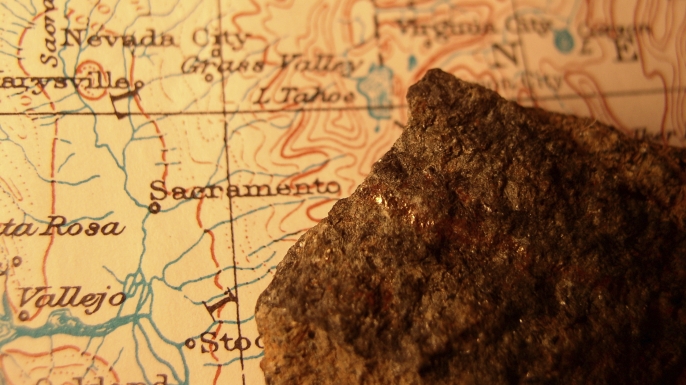

1.) In 1851, Joaquín Murieta—often called the real-life Zorro—and his gang carried out a series of raids on camps in the mountains east of Chico, California. This was the height of the Gold Rush, with thousands of “Argonauts” or forty-niners flooding into both the Mother Lode region (the Sierra foothills east of Sacramento) and the northern mines. Murieta and his crew were known to hide their stolen loot near the sites of their robberies. On one notable occasion, Murieta and his right-hand man, Manuel Garcia—nicknamed “Three-Fingered Jack”—robbed a stagecoach along the Feather River. The strongbox they seized reportedly contained about 250 pounds of gold nuggets, valued at $140,000 at the time. It is said that they buried the strongbox on the banks of the Feather River, in a canyon a few miles south of what is now Paradise in Butte County. According to Wells Fargo officials, the stolen gold has never been recovered.

Another rumored cache belonging to Joaquín Murieta is said to lie somewhere in the eastern high desert region of the northern mines. It’s believed that Murieta buried a stash between Burney and Hatcher Pass, near Highway 299—a treasure that has yet to be discovered. Additionally, a separate treasure valued at $200,000 in 1860s dollars is believed to be hidden between Susanville and Freedonyer Pass, close to what is now Highway 36. This fortune, too, remains lost to this day.

2.) Richard Barter, also known as “Rattlesnake Dick” and Dick Woods, was born around 1833 in Quebec, Canada, the son of a British officer. While details of his early life are scarce, he was reportedly a wild and reckless youth.
In March 1856, seven men traveling with a mule train over Trinity Mountain, on their way from Yreka to Shasta, were ambushed by a group of five masked bandits and robbed of $25,000 in gold. The bandits buried the gold in several spots on the mountainside before making their escape.
They were captured a few days later. The infamous “Rattlesnake Dick Barter,” known as the Pirate of the Placers, masterminded the robbery, though he was caught stealing mules intended to transport the loot and was unable to participate. About $15,000 of the stolen gold was recovered from a ravine 12 miles from Mountain House, near the headwaters of Clear Creek. However, as the snow melted and spring transformed the landscape, efforts to locate the remaining gold proved unsuccessful. An estimated $10,000—worth many times that amount today—still remains hidden somewhere on the mountain.
The final heist took place when Rattlesnake Dick joined forces with the Skinner brothers. Instead of returning to his old stomping grounds in the Mother Lode, he focused on the lucrative northern mining areas. The robbery went off without a hitch, but a Wells Fargo-organized posse was quickly on their trail. The gang split up to evade capture. George Skinner was supposed to rendezvous with Rattlesnake Dick and the others in Folsom, but the gold proved too heavy to carry over the mountain pass. As a result, George decided to bury half of the loot somewhere in the mountains.
No one has been able to find the remaining $40,000 worth of gold bullion buried on Trinity Mountain; even Rattlesnake Dick couldn’t find where George had buried the treasure.

3.) In May 1892, one of the most infamous gold heists put the newly established town of Redding on the map throughout the state. The Ruggles Brothers held up a stagecoach bound for Weaverville, just west of Redding along what is now Middle Creek Road, and made off with a strongbox filled with gold. As the stage rounded a bend, the younger brother, Charles, jumped out from the Manzanita chaparral with his shotgun aimed, ordering the driver to stop. The driver complied—but unknown to the Ruggles, the stage was guarded by an armed escort: Buck Montgomery of the Hayfork Montgomery clan.
In a desperate attempt to save himself and his brother, John told authorities that the stage guard, Montgomery, was working with them. He also disclosed the location of the hidden gold, revealing that it was buried in Middle Creek. To aid in recovering the loot later, John had attached a floating device to the strongbox that stayed just a foot below the water’s surface.

On July 24, 1892, the two brothers were lynched in Redding. A mob dragged them from jail and led them to a tree on the northwest corner where Shasta Street met the railroad tracks—then the site of the Redding Blacksmith Shop, now the backyard of the Paul Stowers Garage. Even on the makeshift gallows, John Ruggles steadfastly refused to reveal the location of the hidden loot.
Authorities went back and scoured the area, and even found the express bag pouch (with letters intact) in the Lower Springs area, but the $5,000 in gold coins still remains undiscovered, though over a century of seekers have tried.
The place to begin is along the unpaved section of Middle Creek Road between Iron Mountain Road and the Shasta Transfer Station in Old Shasta.
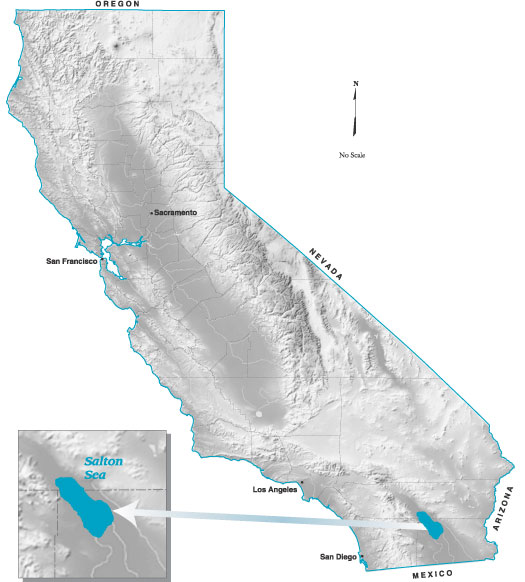
4.) Nestled in the barren, sun-scorched desert of Southern California lies an eerie and otherworldly sight: a vast lake stretching across the cracked, dry earth, surrounded by wind-whipped ghost towns and beaches made not of sand, but of crushed fish bones. This is the Salton Sea—a shallow, salty lake resting along the San Andreas Fault.
Of all the legends about lost and found, and lost again treasures in the Southwest, there is none more mystifying than the enduring tale of a large sailing vessel which lies, full of riches, somewhere in the restless sands of California’s Salton Sea basin, toward the northern end of the Sorora Desert.
Emigrants have reported such a ship, prospectors and other travelers who claim that she lies with her bow buried deep and her richly carved stem raised high above the sands.
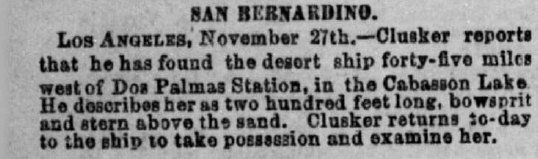
In the 16th century, the Salton Basin was flooded much like it is today, forming a vast lake known as Lake Cahuilla. This enormous body of water, roughly the size of the state of Delaware, was connected to the Sea of Cortez—now called the Gulf of California. It is within this setting that the legend of a lost Spanish galleon, laden with pearls and gold coins, takes root.
According to the story, the galleon ran aground on a sandbar or was caught in a landslide, forcing the crew to abandon ship and make a desperate overland escape through the desert, leaving behind the vessel and its precious cargo of gold and pearls. Over time, as the lake dried up, the ship is believed to have sunk beneath the shifting sands.
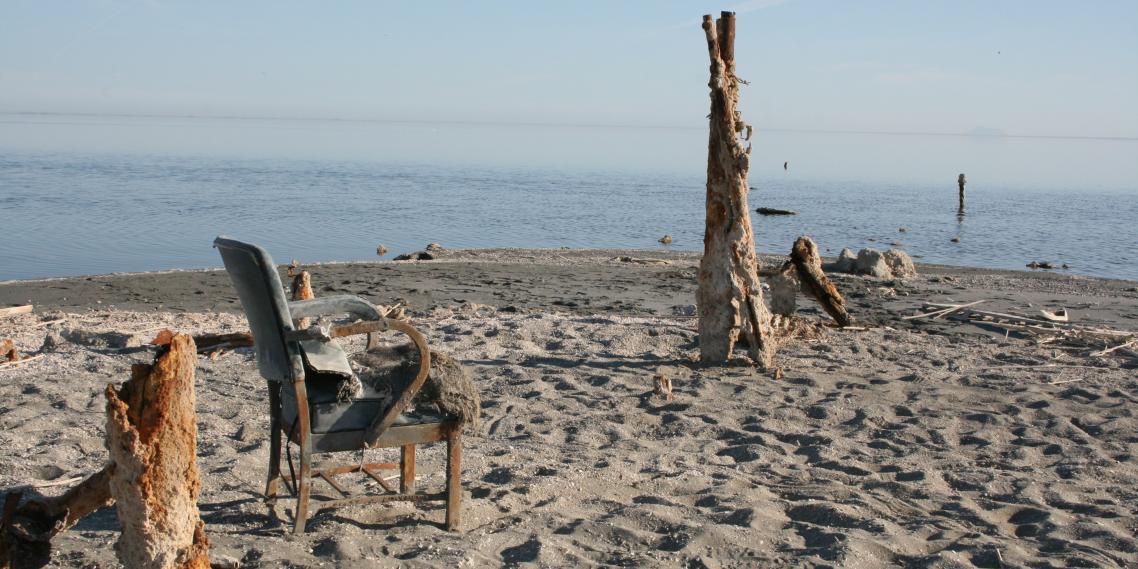
Is there an ancient sailing craft lying half-concealed in the sands of the Colorado Desert?
5.) In the early 1900s, train robber, gunrunner, and—by all accounts—escape artist Roy Gardner began his career of crime across Arizona and California. On April 16, 1920, the curly-haired young outlaw pulled off a daring heist, stealing $78,000 in cash and securities from a mail truck in San Diego, California. Though the robbery went off smoothly, Gardner was caught just three days later. Before long, his name became as infamous to California lawmen as that of Jesse James.
 On May 19, 1921, Gardner boarded the mail car of a Southern Pacific train, tied up the clerk and fled the train in Roseville, California, with $187,000 in cash and securities.
Just two days later, Gardner was arrested once more while playing cards in a pool hall in Roseville, California. Trying to lessen his lengthy sentence, he offered to lead the officers to the stolen money. But after dragging them on a wild goose chase through the nearby hills, he finally admitted, “I guess I’ve forgotten where I buried that money.”

After numerous prison escapes, Gardner was eventually transferred to Alcatraz to serve out his sentence. Despite several unsuccessful appeals for clemency, he remained incarcerated until his release in 1939. He later took his own life in a small hotel room in San Francisco, saying that men who served more than five years behind bars were doomed—and that he was simply old and weary.
Thus ended a criminal career and somewhere, an estimated $250,000 of his loot still remains hidden. Gardner had neither the time nor the opportunity to spend his ill-gotten wealth, nor partners to share it with.
Legend has it that he hid $16,000 in gold coins in the cone of an extinct volcano near Flagstaff, Arizona before he was captured during a train robbery in 1921. But, where is the rest? California?

Not all of California’s lost treasures come from the Gold Rush era. During the wild and unruly days of Prohibition, a German whiskey smuggler named Carl Hause ran a thriving operation. Hause’s base was on Point Reyes Peninsula, near the edge of Drake’s Inlet just south of Inverness. It’s said that he buried around $500,000 in gold-backed currency somewhere between Inverness and the old Heims Ranch. However, the liquor entrepreneur never lived to reclaim his hidden fortune, as he was discovered shot to death in his car. To this day, the buried currency remains lost.
In 1862, the sheriff of Trinity County had the dual role of enforcing the law and collecting taxes. On one trip through the area, he carried about $1,000 in gold coins and $50 in gold slugs in his saddlebag. While cautiously crossing a stream, his horse stumbled, causing the saddlebag to fall into the water and be swept downstream. Despite an immediate search, the sheriff was unable to recover the lost gold. The county soon offered a $250 reward for its retrieval, and determined efforts were made—including damming the creek—but the saddlebag was never found. Back then, assayers and private mines often minted gold slugs, which today are highly collectible and valuable. If recovered now, the lost treasure near Weaverville, California, could be worth up to a million dollars.
Pioneer Peter Lassen became a wealthy landowner and rancher in the 1820s, amassing thousands of acres along the south bank of Deer Creek. He is believed to have buried gold coins and dust in iron pots on his property near his home—either at the confluence of Deer Creek and the Sacramento River in Vina, or along the Lassen Trail that follows Deer Creek. Lassen was killed by Native Americans at the age of 30, and his hidden treasure was never recovered.
In 1859, a stagecoach carrying two boxes of $50 gold slugs valued at $128,000 was held up near Weed. A posse from Mt. Shasta arrived within half an hour and pursued the outlaws. They soon found two pack animals on the western slopes of Mt. Shasta with empty saddlebags. Three miles beyond that point, the posse caught up with the bandits and killed them all. It was believed the gold, too heavy to carry quickly, had been buried nearby. Despite searching the area for a week, the posse never found the hidden treasure.
The Eskridge outlaw gang buried the loot taken from two successful stage robberies near the Upper Bear Creek Crossing in 1881. The treasure has been estimated between $50,000 and $120,000 and has never been recovered.
John Ellison Trueblood arrived in California in 1852 and settled on a farm just outside Red Bluff. He buried his savings—100 to 200 rare octagonal $50 gold slugs—in an iron pot somewhere on his property. Tragically, he was killed during a dispute over the Southern Pacific Railroad encroaching on his land, and the secret of his hidden gold died with him. Today, that treasure is estimated to be worth between $500,000 and $1 million.
In the 1860s, the Langley family operated a profitable gold mine in the Cherokee Hills near Cherokee (GT). During their mining, they discovered a significant amount of raw diamonds and amassed a large collection of gold dust and nuggets. For safekeeping, they hid two saddlebags filled with their precious gold and diamonds about a half-hour horseback ride upstream from their camp. Tragically, bandits attacked the family, and the brother who concealed the treasure was killed. Without knowing the exact location of the cache, the family was never able to recover it. Today, the remains of a washout dam mark the site of the old Langley campsite.
LOST GOLD MINES IN CALIFORNIA
Whether these tales of lost mines are fact or fiction, their legends are still alive for hopeful prospectors of California.
Cement Gold Mine of Mammoth Mountain
Goose Egg Mine of El Dorado County
Kanaka Jack’s Mine in Mother Lode Country
Gunsight Mine of Death Valley
Lost Pegleg Mine
 Wander Woman