ELBERT COUNTY, GEORGIA
An anonymous stranger. Ten controversial commandments. A monument built to outlast generations, and destroyed in a single morning.
There are places you visit because of their history, places you visit because of their beauty, and then there are places you visit because something about them simply doesn’t make sense. The Georgia Guidestones fell into that last category.
I had read about the mysterious granite monument long before I ever made the drive into rural Georgia. A structure commissioned by a man who refused to reveal his identity, carrying instructions for humanity in eight different languages, standing in the middle of the countryside like a message intended for some future civilization. Naturally, I wanted to see it for myself. What I hadn’t expected was that getting there would be almost as memorable as the monument itself.
The Long Road Into Elbert County
The farther I drove into the Georgia countryside, the more it felt as though I had wandered onto the set of an old Southern movie. The highways gave way to backroads, the towns grew smaller, and the scenery became a patchwork of farmland, woods, and buildings that looked as though they had been standing for generations.
Every so often, I’d pass a roadside flea market with tables of miscellaneous treasures spread out beneath the sun. There were old gas stations that had clearly seen better decades, the kind of places where you might stop for a cold drink and end up hearing someone’s entire life story. At one of them, people were gathered outside playing country and folk music. Not music coming from a radio. Real people, sitting around playing instruments as though it were the most ordinary thing in the world.
I remember thinking how much it reminded me of something you’d see in a movie. The sort of scene that seems almost too perfectly Southern to be real, but there it was, and somewhere beyond those little roadside scenes, out among the rolling hills of Elbert County, stood one of the strangest monuments ever constructed in America.
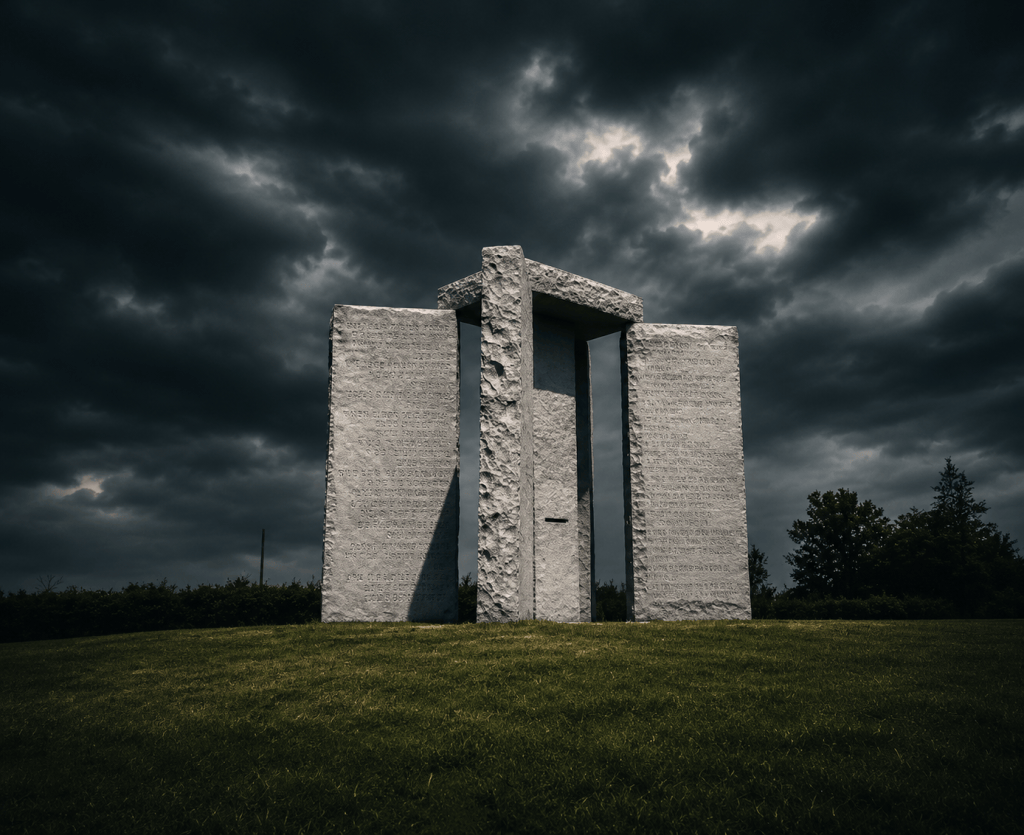
I followed the roads until I finally reached the hilltop where the Georgia Guidestones stood, and when I arrived, there wasn’t another person in sight. Just me, the open landscape, and five enormous slabs of granite holding a message from someone who didn’t want the world to know his name.
By the time I reached the Guidestones, dark storm clouds were beginning to roll across the countryside, slowly swallowing what remained of the afternoon sunlight. There was something unsettling about the sky, as though the weather itself was adding to the mystery of the place, and if you’ve ever experienced a Georgia thunderstorm, you know they’re a whole different kind of storm. The thunder doesn’t just rumble—it shakes the ground, and the sky can turn from blue to nearly black in a matter of minutes. Standing alone on that exposed hilltop, watching the clouds gather above those towering granite stones, I couldn’t help but wonder how much time I had before the storm caught up with me.
A Monument With No Name Behind It
The first thing that struck me was how out of place the Guidestones seemed. They weren’t part of an ancient archaeological site. They weren’t the remains of a forgotten civilization, and they weren’t standing in the center of some grand historical park. They were modern. Yet everything about them seemed designed to suggest something much older.
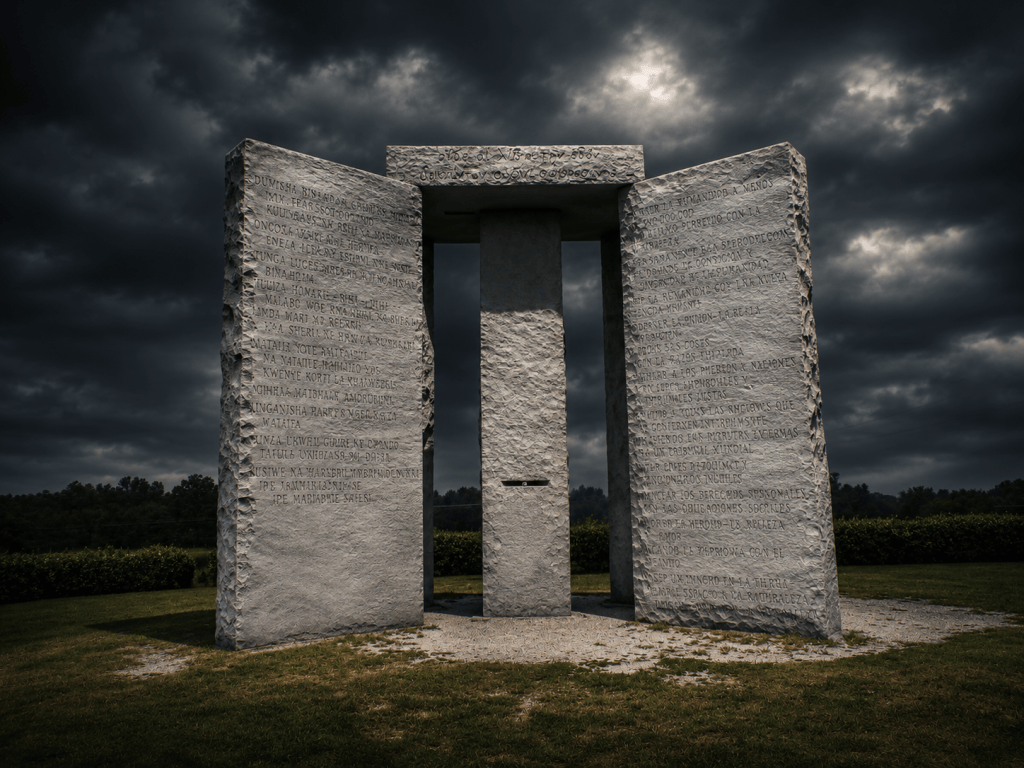
Four towering granite slabs stood beneath a massive capstone, arranged with geometric precision. The monument rose nearly twenty feet above the hilltop, its polished surfaces covered in carefully engraved words. People had nicknamed it the American Stonehenge, and standing there looking up at it, I could understand why, but unlike England’s prehistoric monument, nobody had to speculate about when the Georgia Guidestones were built. The mystery was who wanted them built and why.
The story began in June 1979, when a stranger walked into the offices of the Elberton Granite Finishing Company. He introduced himself as R. C. Christian. That wasn’t his real name. He claimed to represent a small group of Americans who wanted to create a monument carrying a message for humanity. The structure would need to withstand the passage of time, and its inscriptions would express principles the sponsors believed future generations should follow.
He had specific instructions, ambitious engineering requirements, and the financial means to make the project happen. There was just one condition. His identity, and the identities of those involved, were to remain confidential. Imagine being the granite company employee listening to that proposal. A stranger appears, requests an enormous monument with instructions for the future of civilization, and insists that nobody ever learn who he really is. It sounds like the beginning of a mystery novel. Except this actually happened. The monument was unveiled on March 22, 1980, and for decades afterward, the public was left with a towering granite riddle.
Ten Instructions for a World That Didn’t Exist
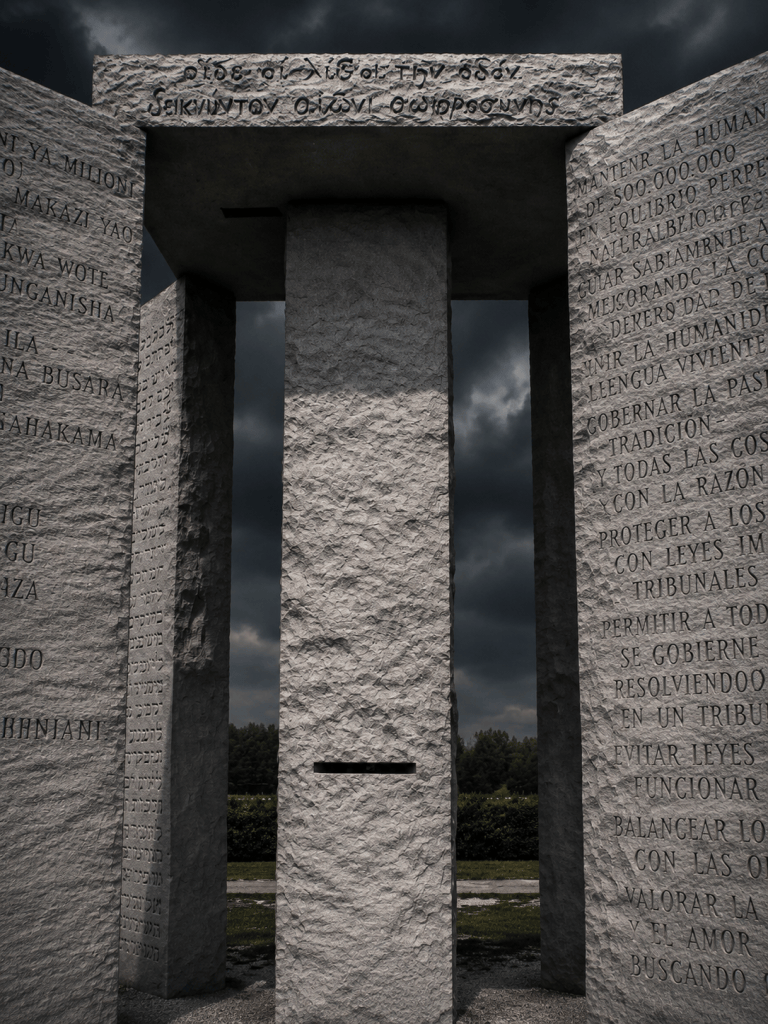
Standing before the stones, I found myself studying the inscriptions. They weren’t prayers or commemorations of a battle or tributes to some famous historical figure. They were instructions. Ten principles, engraved in English, Spanish, Swahili, Hindi, Hebrew, Arabic, Chinese, and Russian. The capstone also carried a shorter message in four ancient writing systems.
Some of the principles sounded relatively harmless, even admirable. They called for fair laws, justice, reason, truth, beauty, and a balance between individual freedom and responsibility to society. Others were considerably more unsettling. Especially the first.
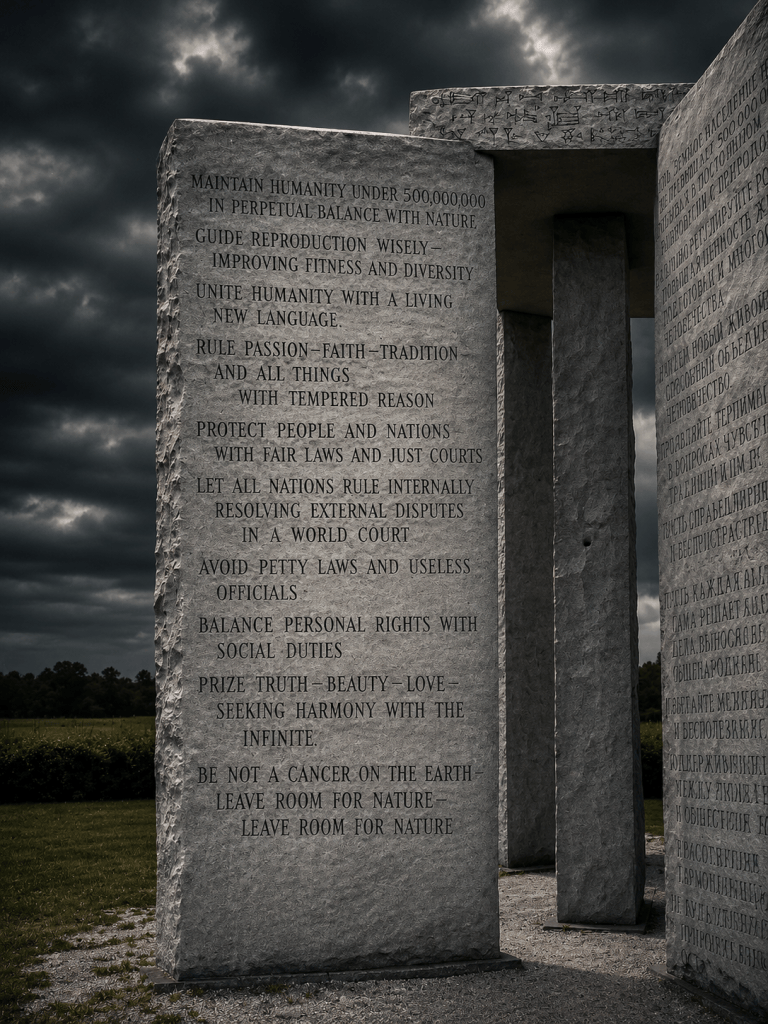
“Maintain humanity under 500,000,000 in perpetual balance with nature.”
Five hundred million people. At the time the monument was erected, the world’s population was already several billion. So, what exactly were the sponsors suggesting? Were they imagining a future after some catastrophic event had already reduced humanity’s numbers? Were they advocating strict population controls? Or was the inscription simply an idealized, deeply controversial vision of environmental sustainability? The stones didn’t explain, and the man who commissioned them wasn’t standing nearby to answer questions.
The second principle only deepened the controversy:
“Guide reproduction wisely improving fitness and diversity.”
That wording raised uncomfortable questions about reproductive control and eugenics. Even if the sponsors intended something less sinister, the language was open to interpretations that understandably disturbed many readers. Other inscriptions proposed a shared language for humanity, international mechanisms for resolving disputes, and a society governed by reason rather than unchecked passion or tradition.
Taken together, they presented a vision of civilization that was part environmental manifesto, part philosophical declaration, and part blueprint for a different kind of world. Whether that world sounded peaceful or frightening depended largely on who was reading the stones, and perhaps that was what made them so fascinating.
More Than Words Carved Into Granite
The Guidestones weren’t simply an oversized stone tablet. They had been designed with astronomical features. A narrow channel aligned with the celestial pole, allowing observers to locate Polaris. Another opening was arranged to track the sun’s annual movement, while a small aperture in the capstone allowed a beam of sunlight to fall onto the central stone around noon.
The monument was both a message and a carefully engineered structure. That combination made its purpose even more intriguing. Why go to such lengths? If the goal was simply to share a philosophy, a book would have been easier. A newspaper advertisement would have reached more people. Even a permanent plaque in a public square would have required far less effort.
Instead, someone paid to have an enormous granite monument constructed on a Georgia hilltop, complete with astronomical alignments and messages in languages from around the world. It was designed to endure. Perhaps the sponsors believed their words would matter centuries from now, long after the people who wrote them had disappeared. Or perhaps they wanted the monument itself to become a mystery. If so, they succeeded.
Theories, Secrets, and the Man Called R. C. Christian
It didn’t take long for theories to develop around the Guidestones. Some believed the monument was connected to secret societies or wealthy individuals attempting to shape the future of humanity. Others pointed to the initials and surname R. C. Christian, suggesting a connection to Rosicrucian traditions. There were accusations involving occult organizations, global conspiracies, and plans for a new world order. The more mysterious the sponsors remained, the more elaborate the theories became, but suspicion isn’t evidence.
No reliable proof established that the Guidestones were commissioned by an occult hierarchy or an organization secretly controlling world events. What was documented was strange enough on its own. A man using an assumed name had arranged for a massive monument to be constructed, represented an unidentified group, and insisted on secrecy. That much was real, and it was more than enough to keep people wondering.
Years later, an investigation pointed toward Herbert H. Kersten, an Iowa physician whose writings about overpopulation appeared to echo some of the monument’s principles. The evidence was intriguing, but the identification did not settle every question about the people behind the Guidestones. Even if Kersten was the man who called himself R. C. Christian, the identities of the other people reportedly involved remained uncertain.
Who were they? How many were there? And what convinced them that their vision for humanity needed to be preserved in granite? The possible identification of one man offered a glimpse behind the curtain, but it didn’t explain everything.
The Strange Little Stone Marked 2014
As if the original monument hadn’t inspired enough speculation, another mystery appeared decades later. In 2014, a small granite block bearing the number 2014 was discovered within a notch in the monument. Photographs and reports of the block quickly circulated, with people debating whether it had some hidden meaning.
Some saw it as evidence that the original sponsors were still involved. Others interpreted it as a coded message or a sign of some approaching event, but there was no verified evidence connecting that stone to the original sponsors. Still, the incident added another strange chapter to a place already surrounded by unanswered questions, and the Guidestones continued to attract visitors who came not just to see the monument, but to decide for themselves what it meant.
The Morning the Stones Fell
For more than forty years, the Georgia Guidestones stood on their hilltop. They survived storms, changing seasons, vandalism, public outrage, and endless conspiracy theories. Then, on July 6, 2022, everything changed. Before dawn, an explosion shattered the quiet countryside outside Elberton. The Georgia Bureau of Investigation confirmed that an explosive device had been detonated at the monument at approximately 4 a.m., severely damaging one of its granite pillars.
Surveillance footage released by investigators captured the moment of the blast, showing the explosion tearing through the structure and scattering fragments of granite. The damage was extensive. Later that same day, the remaining portions of the monument were demolished for safety reasons. In less than twenty-four hours, a landmark that had stood for more than four decades was gone.
The Georgia Bureau of Investigation opened an investigation into the bombing and released surveillance images to identify those responsible. The footage also showed a vehicle leaving the area shortly after the explosion, but identifying the person behind the destruction proved far more difficult than documenting what had happened. The bombing remained unsolved in subsequent public reporting, with no publicly established identity or motive for the person responsible. The destruction followed years of controversy surrounding the monument’s inscriptions.
During Georgia’s 2022 gubernatorial campaign, candidate Kandiss Taylor had publicly condemned the Guidestones, describing them as satanic and promising to have them demolished if elected. Her statements attracted attention, particularly because the monument was destroyed only weeks later, but there was no established evidence linking Taylor to the bombing, and her public opposition should not be mistaken for proof of involvement.
What investigators confirmed was the explosion itself, the damage it caused, and the subsequent demolition. Who planted the explosive device and why remained unanswered. For decades, people had wondered who was responsible for building the Georgia Guidestones. Now there was another mystery attached to the same lonely hilltop. Who had wanted them destroyed?
What Was Really Lost?
I understand why the inscriptions made some people uncomfortable. The first two principles, especially, deserve scrutiny. Any proposed vision for humanity involving population limits and reproductive guidance raises serious ethical questions, but there is a difference between questioning an idea and destroying the object that expresses it.
The Guidestones were a physical piece of modern American history. They represented a peculiar moment when an anonymous group decided to carve its philosophy into granite and leave it on a hilltop for the world to examine. You didn’t have to agree with the message to recognize how unusual that was.
In fact, disagreement was part of what made the monument worth discussing. It invited questions about environmental responsibility, individual freedom, population growth, political power, and who gets to decide what a better world should look like. Those questions didn’t disappear when the stones came down. Only the monument did.
The Hilltop I Remember
When I think back on my visit, I don’t immediately remember the conspiracy theories or the political controversy. I remember the drive. The little flea markets along the backroads. The worn-down gas stations. The people playing country music outside, seemingly unconcerned with the rest of the world. I remember how ordinary everything seemed, right up until I reached that hilltop, and I remember being the only person there.
There was something strange about standing alone in front of those enormous stones, reading instructions for the future of humanity written by someone who had gone to extraordinary lengths to remain unknown. No crowd. No one offering an explanation. Just a quiet Georgia landscape and a monument that seemed to have more questions attached to it than answers. I had no idea that one day it would be gone. Had I known, perhaps I would have stayed a little longer. Taken a few more photographs. Spent more time looking at the inscriptions and wondering about the people who had arranged for them to be carved. I’m grateful I had the chance to see the Guidestones while they were still standing.
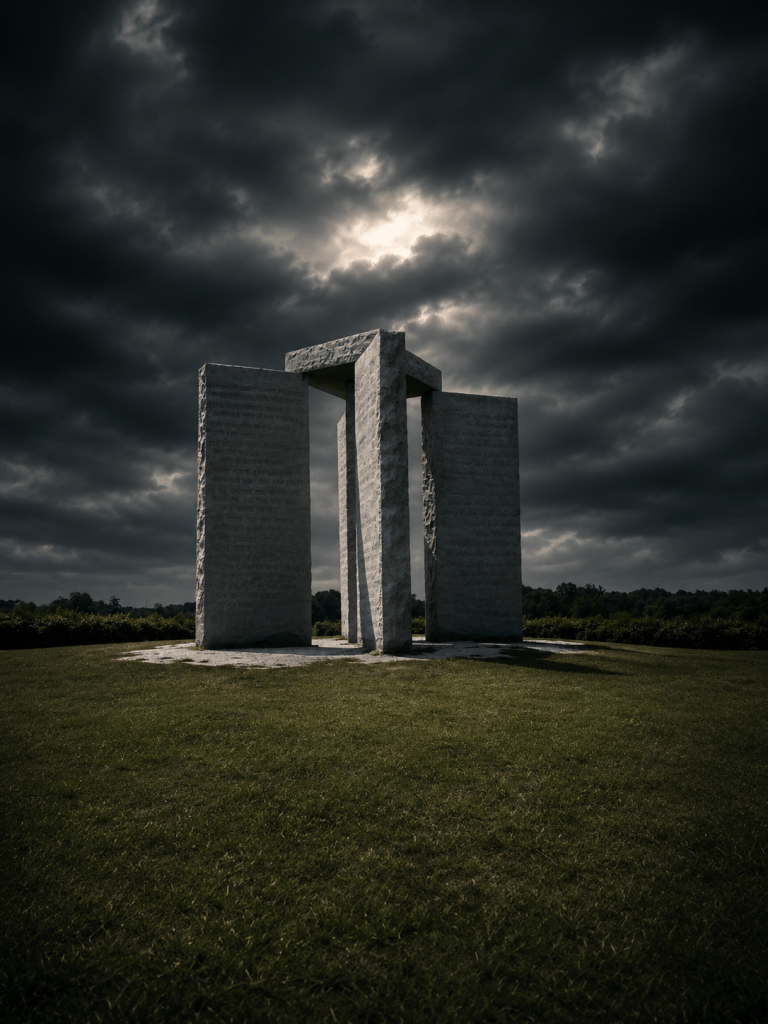
Today, the hilltop no longer holds the towering granite structure that brought me there, but the story hasn’t ended. The stones are gone. The debates remain, and the bombing has added another unresolved chapter to their history. Maybe the greatest mystery was never whether the Guidestones held some secret plan for humanity. Maybe it was why someone believed so strongly in a message that they built a monument intended to last for centuries—while refusing to put their own name on it, and why, forty-two years later, someone else wanted that message silenced badly enough to blow it apart.
The Georgia Guidestones may have disappeared from the landscape, but their unanswered questions are still standing.
The remaining 8 commandments were as follows:
Unite humanity with a living new language
Rule Passion – Faith – Tradition – and all things with tempered reason
Protect people and nations with fair laws and just courts
Let all nations rule internally resolving external disputes in a world court
Avoid petty laws and useless officials
Balance personal rights with social duties
Prize truth – beauty – love – seeking harmony with the infinite
Be not a cancer on the earth – Leave room for nature – Leave room for nature
- Rule Passion – Faith – Tradition – and all things with tempered reason
- Protect people and nations with fair laws and just courts
- Let all nations rule internally resolving external disputes in a world court
- Avoid petty laws and useless officials
- Balance personal rights with social duties
- Prize truth – beauty – love – seeking harmony with the infinite
- Be not a cancer on the earth – Leave room for nature – Leave room for nature
- Unite humanity with a living new language
- Rule Passion – Faith – Tradition – and all things with tempered reason
- Protect people and nations with fair laws and just courts
- Let all nations rule internally resolving external disputes in a world court
- Avoid petty laws and useless officials
- Balance personal rights with social duties
- Prize truth – beauty – love – seeking harmony with the infinite
- Be not a cancer on the earth – Leave room for nature – Leave room for nature

